What's production-ready in AI automation right now
A mid-2026 status report: what has become routine engineering, what is still fragile, and what the analysts expect to fail.
Two things have happened at once over the last couple of years. The tools for building AI automation have matured quickly, and the marketing around them has got louder. Here's where things stand as of mid-2026, based on published guidance and what we see in practice.
Routine: retrieval over your own documents
Retrieval-augmented generation has moved from research topic to standard engineering. With sensible chunking, a good embedding search and a reranker, answering questions from a company's own knowledge base is reliable work. The open problems are mostly about long, messy document sets, where research such as Liu et al.'s “Lost in the Middle” shows models still struggle with information buried mid-context.
Routine: narrow agents with few tools
Anthropic's guidance on building agents found the most successful teams used simple, composable patterns: prompt chaining, routing, parallel calls, and agents with a small set of well-defined tools. Tool connections have also become easier to standardise, with protocols such as the Model Context Protocol, introduced in late 2024, now widely supported.
Cheaper than ever: running models at all
The Stanford AI Index 2025 reports that the cost of GPT-3.5-level performance fell around 280-fold between late 2022 and late 2024. For many tasks, cost has stopped being the reason not to automate.
Still fragile: long autonomous chains without review
Chaining many model calls with no human checkpoint still looks better in demos than in production, because small errors compound at each step. Gartner's June 2025 forecast that over 40% of agentic AI projects will be cancelled by the end of 2027 points to costs, unclear value and weak risk controls, not model capability. If a step makes a decision a customer would want checked, put a review gate there.
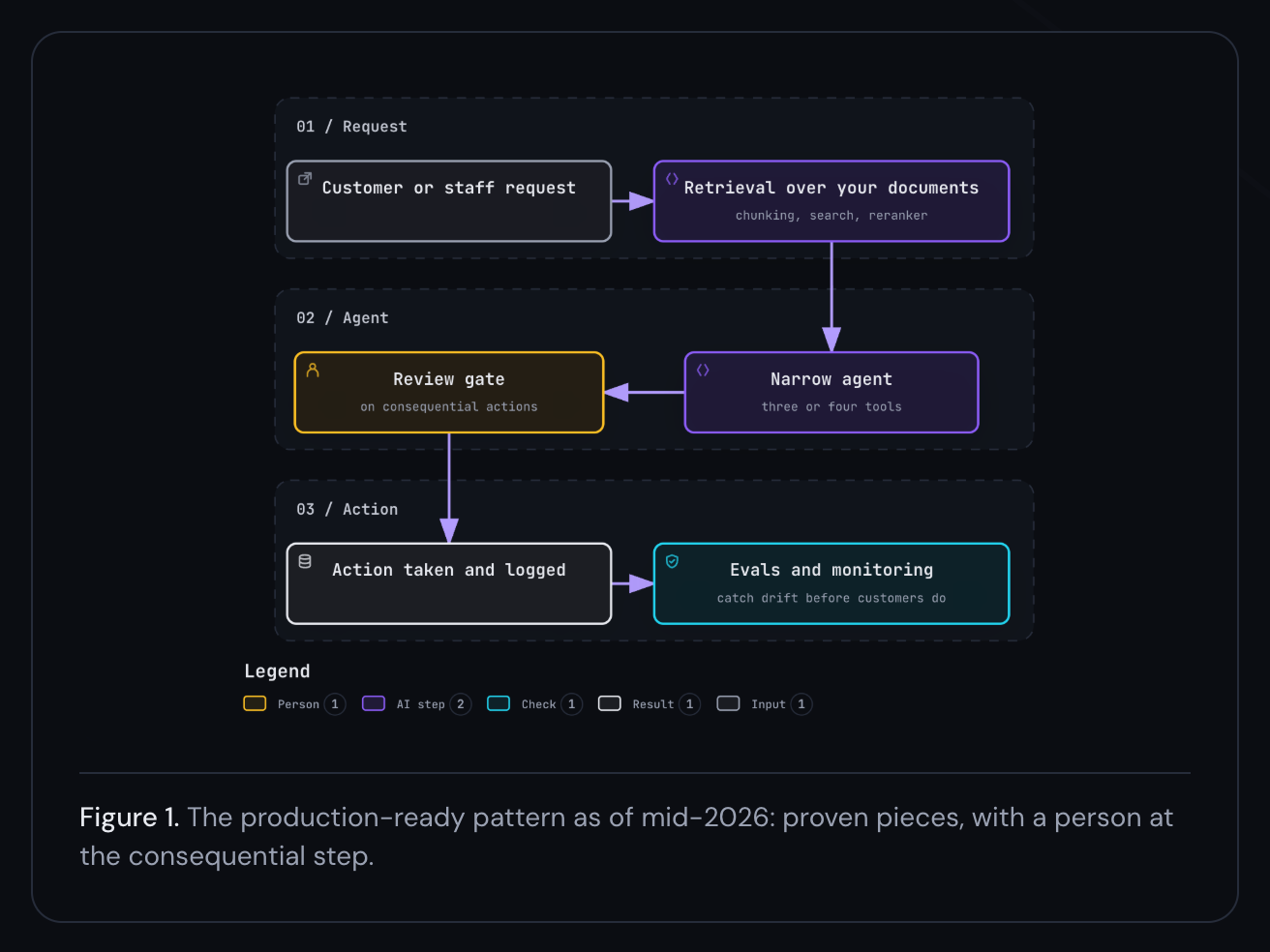
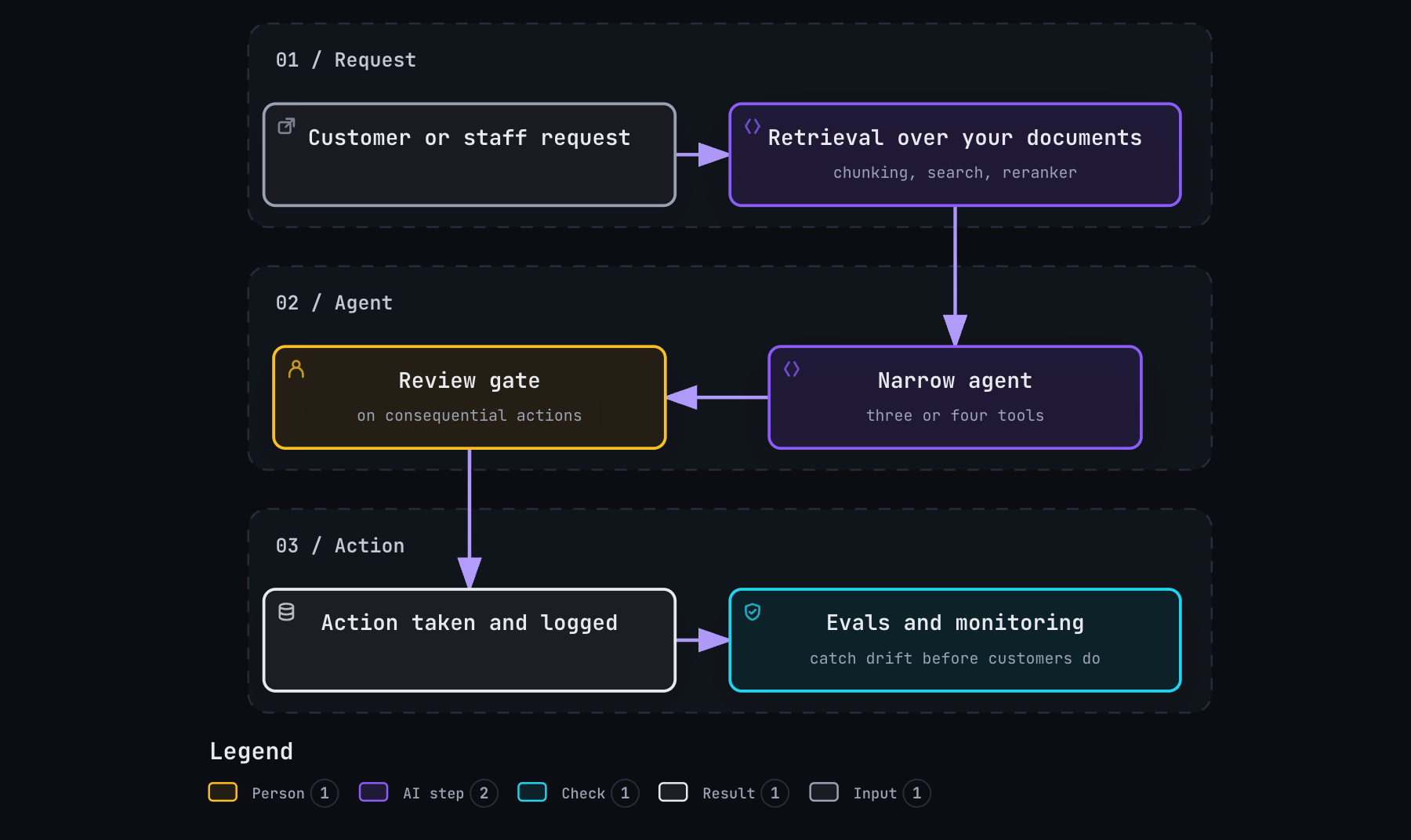
Scroll sideways to see the whole diagram.
Hype: “set it and forget it”
Any pitch for fully autonomous automation should be able to answer one question: what happens when real data looks nothing like the demo data? Gartner's finding that only a small fraction of “agentic” vendors offer real agentic capability is a good reason to ask.
Where X-GenAI fits
We build with the routine, proven patterns first, and add evaluation and monitoring so you can see when something starts to slip.
Sources
Anthropic (December 2024). Building effective agents.
Stanford HAI (2025). The 2025 AI Index Report.
Gartner (25 June 2025). Gartner Predicts Over 40% of Agentic AI Projects Will Be Canceled by End of 2027. Press release.
Liu, N. F. et al. (2024). Lost in the Middle: How Language Models Use Long Contexts. TACL, 12, 157–173.
Get new posts by email
AI updates, trend breakdowns, and picks for the certifications worth your time, a few times a month, when something's worth sending.
Have something like this to automate?