AI automation in education: where it fits and where regulators draw the line
UNESCO's guidance, the UK Children's Code and the EU AI Act all point the same way: AI can take on school admin, but decisions about students need a much higher bar.
Abstract. Schools, universities and education technology providers carry a heavy load of repetitive administrative work, and they also work under some of the strictest expectations about data and decisions. This piece reviews three policy sources (UNESCO's 2023 guidance on generative AI in education, the UK Information Commissioner's Age Appropriate Design Code, and the EU AI Act) and uses them to separate administrative uses of AI from uses that affect students directly.
Background
UNESCO published its Guidance for generative AI in education and research in September 2023, the first global guidance of its kind. It calls for data protection safeguards, for institutions to validate AI tools before students use them, and suggests a minimum age of 13 for classroom use of generative AI tools, while noting that many commentators think that is too young.
In the UK, the ICO's Age Appropriate Design Code (the Children's Code), in force since September 2021, sets standards for online services likely to be used by children, including high privacy by default and data minimisation.
The EU AI Act lists several education uses as high risk in Annex III: AI used to decide admission or access, to evaluate learning outcomes, to assess what level of education someone should receive, and to monitor students for prohibited behaviour during tests. High-risk systems carry obligations around risk management, data quality, logging, transparency and human oversight.
Analysis: two categories of use
Read together, these sources separate AI use in education into two broad groups.
Administrative support. Timetabling help, drafting (not sending) replies to common questions from parents and students from a knowledge base, summarising long feedback threads for staff, and organising enquiries. These are a good fit for automation, provided a person with context approves anything that goes out and student data is kept to a minimum.
Decisions about students. Admissions decisions, grading, placement and exam monitoring fall into the AI Act's high-risk categories where it applies, and involve exactly the kind of personal data the Children's Code is concerned with. Even outside the EU, they deserve more review gates, more logging and an honest discussion of whether automation is the right tool at all. Admissions triage that sorts and routes enquiries is very different from a system that decides who gets a place.
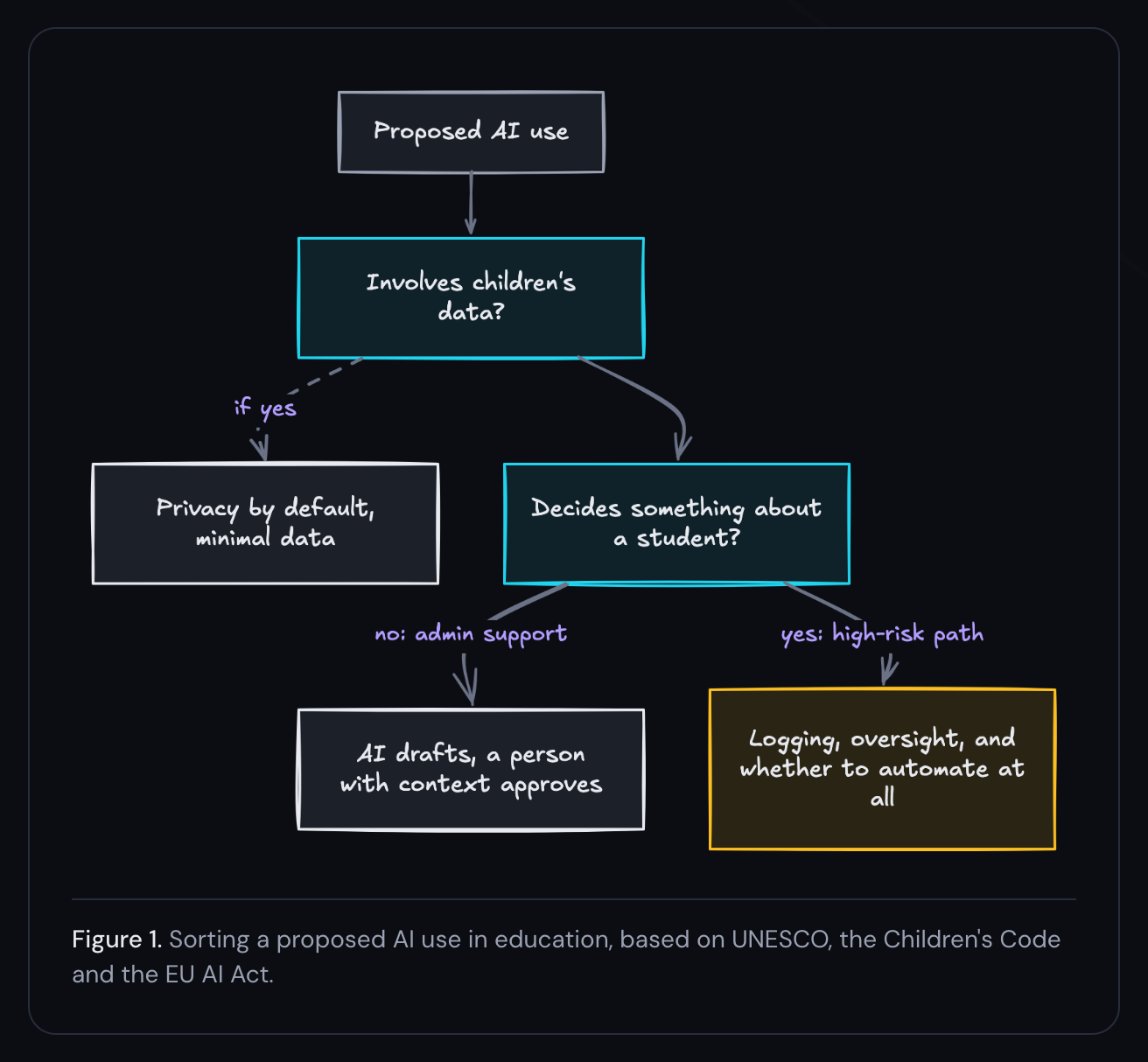
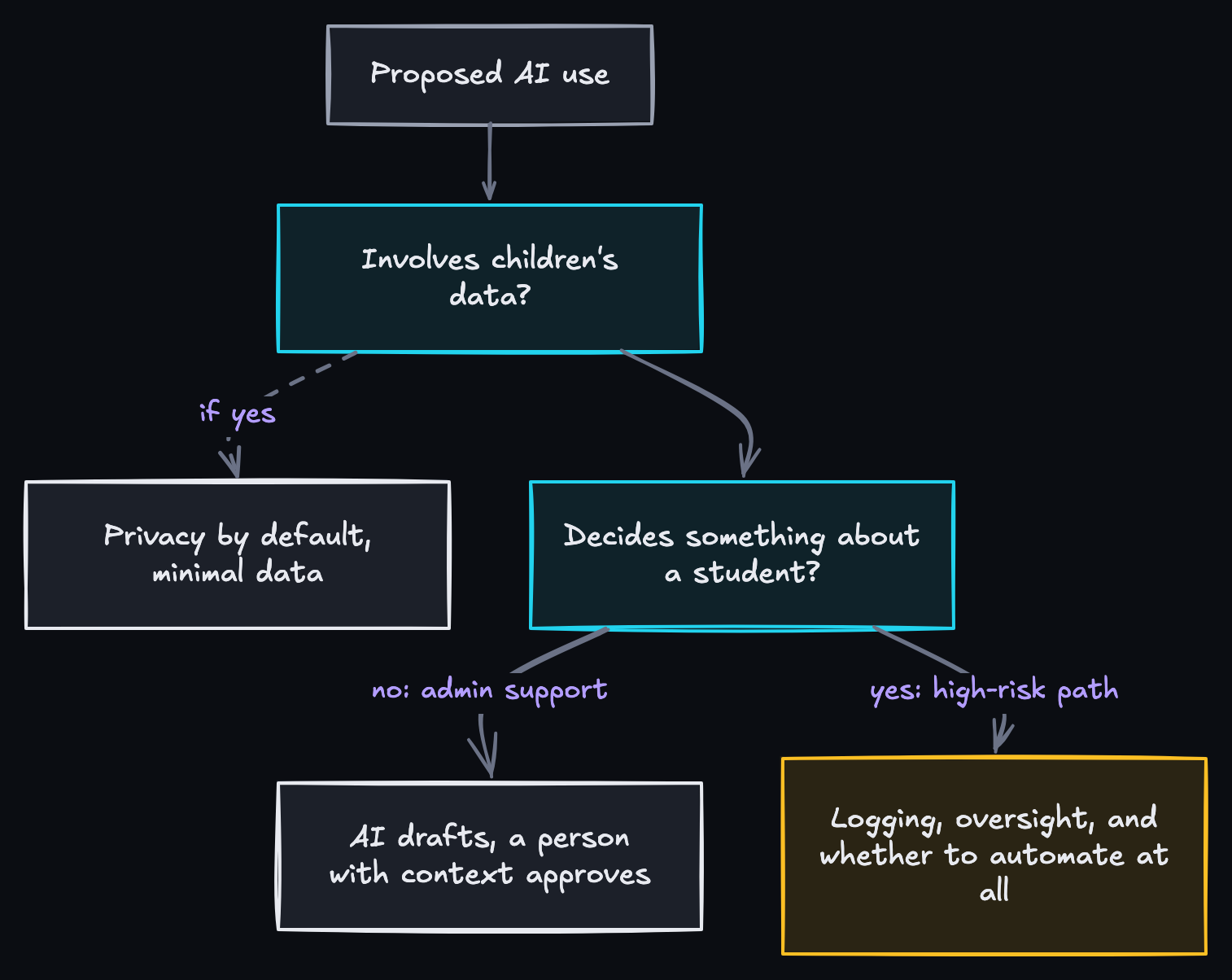
Scroll sideways to see the whole diagram.
Discussion
The practical consequence is that data and compliance questions come first in education projects, not last. Before any build: what student data does this touch, does it involve children, who can see the outputs, and does the use fall into a high-risk category? Answering those early is much cheaper than retrofitting them.
Limitations
This is a summary of policy documents, not legal advice. The AI Act's timetable for high-risk obligations has been revised during 2026, and rules differ by country. UNESCO's guidance is advisory rather than binding.
Conclusion
AI can take a lot of repetitive admin off education staff. The line that policy keeps drawing is between helping staff and making decisions about students, and the second needs a much higher bar.
Where X-GenAI fits
For education clients, our Discovery Audit starts with the data and oversight questions above before any automation is scoped.
References
UNESCO (2023). Guidance for generative AI in education and research. UNESCO, Paris.
Information Commissioner's Office (2020). Age appropriate design: a code of practice for online services.
Regulation (EU) 2024/1689 (Artificial Intelligence Act), Annex III, point 3.
Get new posts by email
AI updates, trend breakdowns, and picks for the certifications worth your time, a few times a month, when something's worth sending.
Have something like this to automate?