How to actually keep up with AI (without the doom-scrolling)
The biggest AI story of the last few years for most businesses wasn't a benchmark. It was a roughly 280-fold fall in what a given level of capability costs to run.
Most AI news is a model launch with a leaderboard, or a prediction about jobs. Neither tells someone running a business what changed this month. The trend that has changed the most for businesses got far less coverage, and it's a good example of what to watch instead.
The trend that mattered: cost per unit of capability
Stanford's 2025 AI Index tracked the price of running a model that scores at least GPT-3.5's level on the MMLU benchmark. Between November 2022 and October 2024 it fell from about $20 to about $0.07 per million tokens, a drop of roughly 280 times. The report draws on pricing data from Epoch AI and Artificial Analysis.
That number explains more about business adoption than any single launch. A task that was too expensive to automate on every request two years ago may now cost fractions of a cent. Quality improved too, but for most practical work it was cost that moved things from “interesting” to “worth doing.”
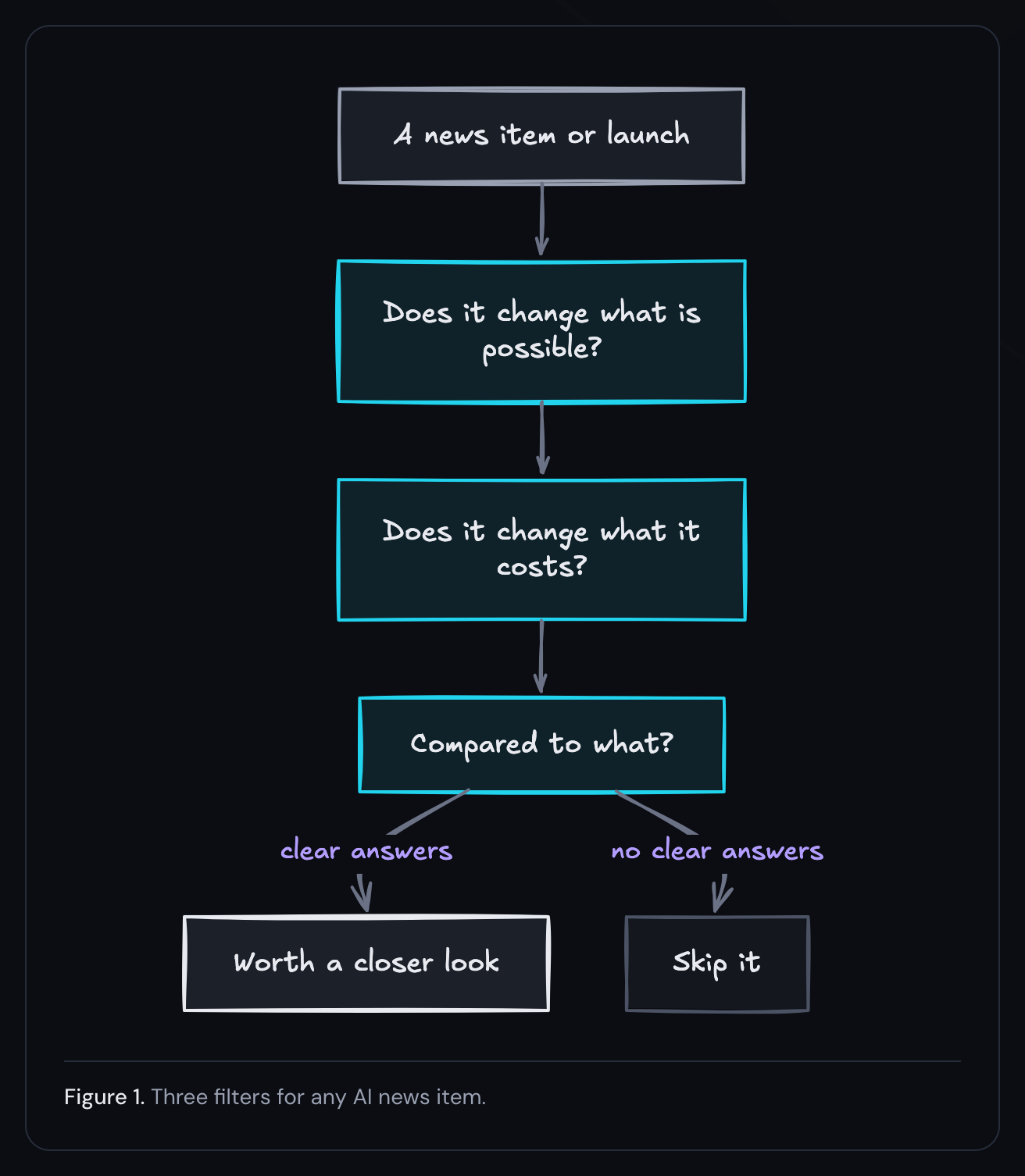
Three filters for the rest of the news
- Capability, not version numbers. A new model name isn't news. What it can do that the last one couldn't is: longer usable context, reliable tool use, lower cost, fewer errors on a specific kind of task.
- Price per token alongside quality. A small quality gain at ten times the price is often worse for your use than a slightly older model at a tenth of the cost.
- “Compared to what?” Claims that AI will replace X or can now do Y only mean something against a baseline. At what cost, how reliably, under what conditions? If a claim can't answer that, treat it as marketing.
A short reading list
The model providers' changelogs and pricing pages, which change less often and say more than their blogs. The annual Stanford AI Index for the long view. Epoch AI for data on compute and cost trends. And one or two independent evaluation leaderboards for the kind of task your work depends on.
Where X-GenAI fits
Our newsletter is written with these filters, and our consulting work includes checking whether a cheaper model now does the job you're paying more for.
Sources
Stanford Institute for Human-Centered AI (2025). The 2025 AI Index Report.
Epoch AI, data on AI compute and costs.
Get new posts by email
AI updates, trend breakdowns, and picks for the certifications worth your time, a few times a month, when something's worth sending.
Have something like this to automate?