The environmental cost of AI, and where it actually sits
Data centres used about 1.5% of the world's electricity in 2024, and the IEA expects that to roughly double by 2030. The research says the part most businesses control is inference, and model choice.
Abstract. AI's environmental footprint is usually discussed in terms of training very large models. This piece reviews the evidence on where energy use actually accumulates, drawing on the International Energy Agency's 2025 analysis and peer-reviewed measurements of training and inference. The research suggests that for most organisations the footprint they can influence is inference, and that the choice of model for each task changes energy use by orders of magnitude.
Background
According to the IEA's Energy and AI report, data centres used around 415 TWh of electricity in 2024, about 1.5% of global consumption. Its base case projects roughly 945 TWh by 2030, with electricity demand from AI-optimised data centres more than quadrupling. Large data centres also use water for cooling, and Li and colleagues have estimated that the water footprint of AI workloads is significant and largely unreported.
Evidence: training
Strubell, Ganesh and McCallum's 2019 paper was one of the first to put numbers on the energy and carbon cost of training NLP models, and showed it could be large, especially when extensive tuning and architecture search were included. Patterson and colleagues at Google later found that the footprint of training depends heavily on choices that have nothing to do with model quality: the efficiency of the hardware, the data centre, and the carbon intensity of the local grid could change emissions by large factors.
Evidence: inference
Training happens once. Inference happens every time someone uses the model. Luccioni, Jernite and Strubell measured the energy used by a wide range of models across common tasks. Their clearest finding was that general-purpose generative models used far more energy per task than smaller models built for that one task, often by orders of magnitude, even at similar parameter counts. Generating text was the most energy-intensive kind of task they measured.
Discussion
The usual habit is to reach for the largest, newest model whatever the job. For tasks like routing support tickets or answering from a fixed knowledge base, the evidence says that mostly buys energy use, not better results. A smaller-by-default approach follows directly:
- Start with the smallest model that passes an evaluation set for the task, and move up only when it can't meet the bar.
- Cache answers when the same input comes back.
- Send only the steps that need a large model's judgment to one, and give classification and routing steps to smaller or task-specific models.
- Where you have a choice of region or provider, prefer lower-carbon grids, as Patterson's results suggest.
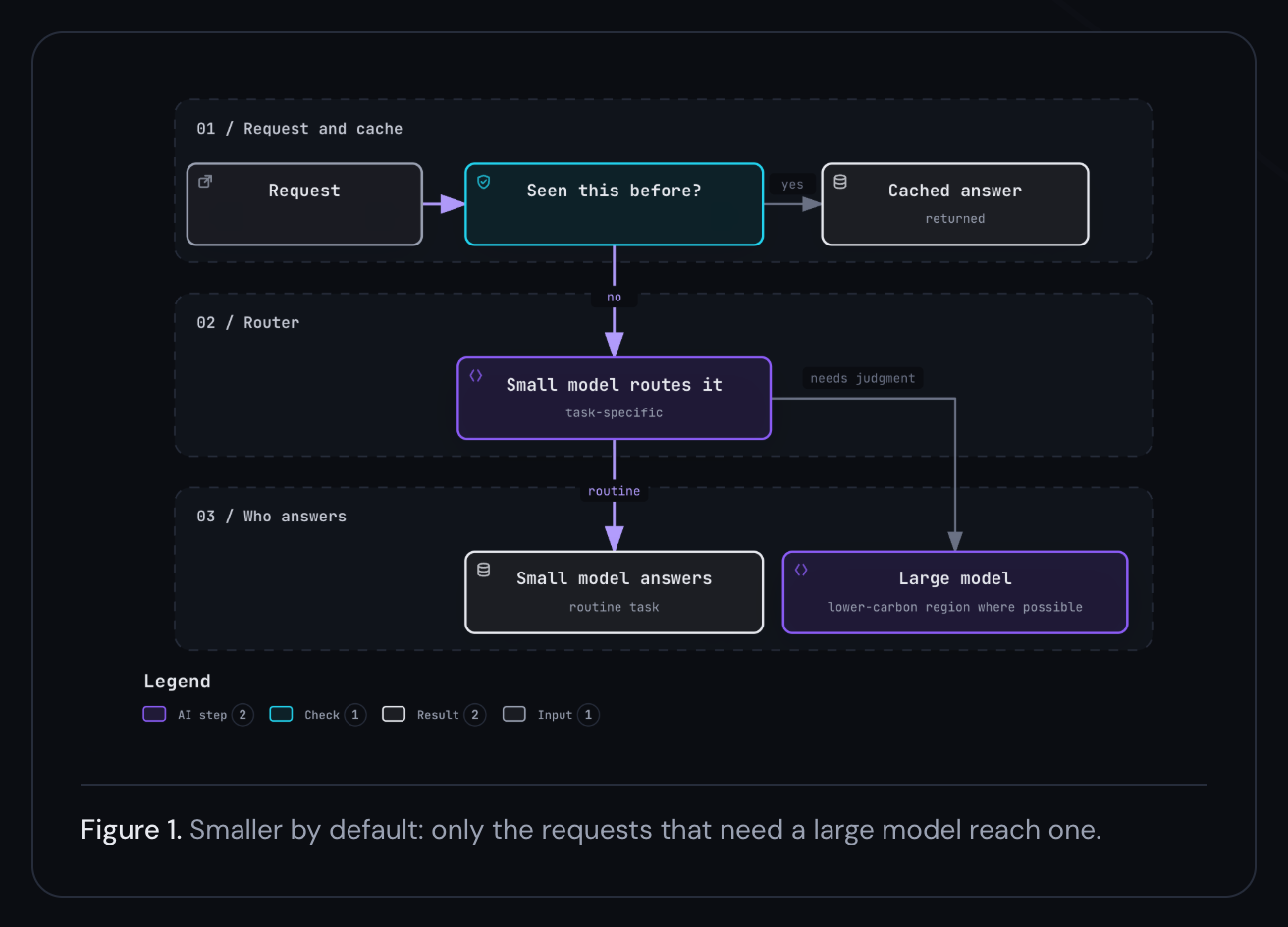
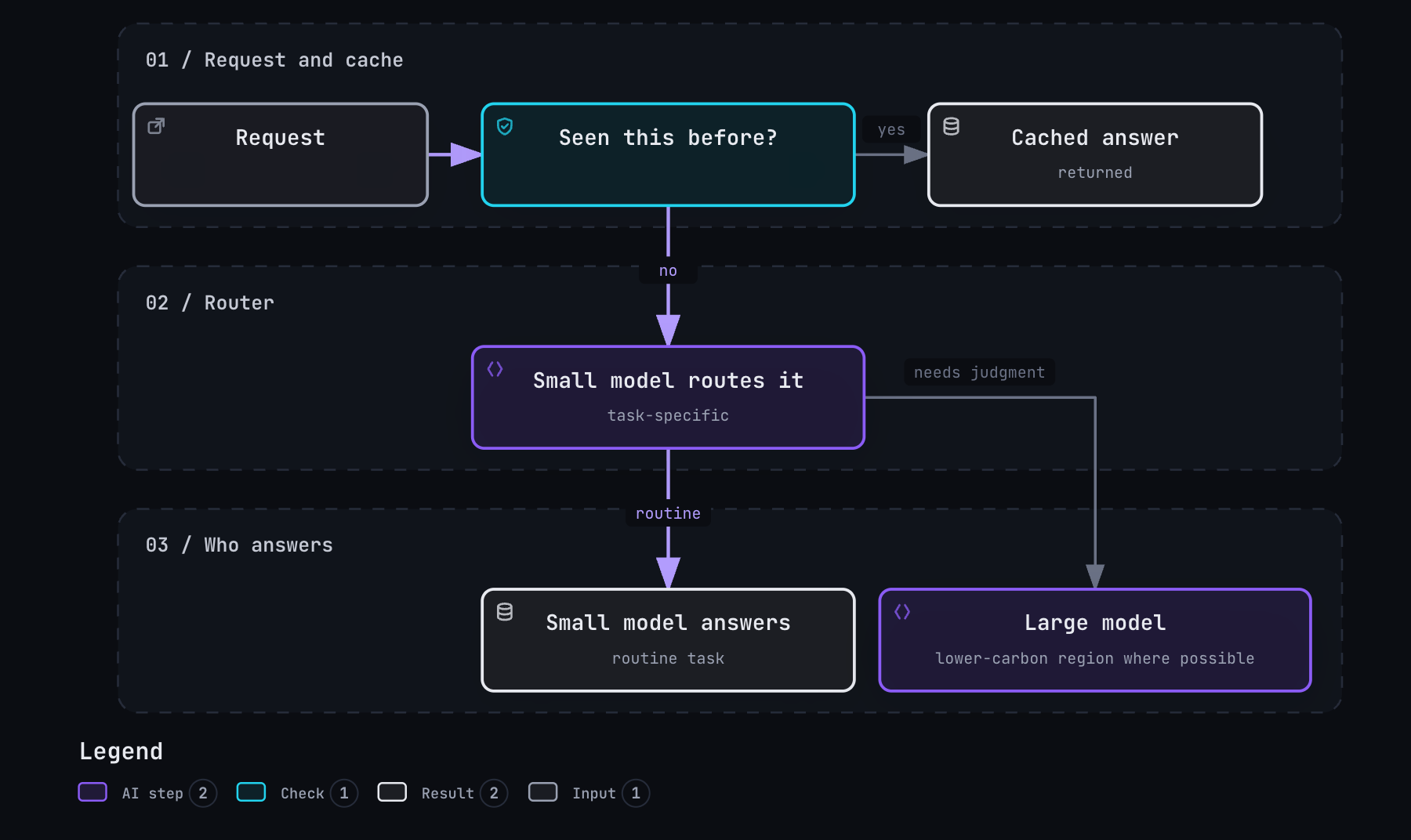
Scroll sideways to see the whole diagram.
Limitations
Energy figures for commercial models are rarely published, so most measurements use open models as a proxy. Per-query estimates vary widely between studies depending on hardware and method. The IEA projections are scenarios with wide ranges, not forecasts. Efficiency gains can also increase total use if they make AI cheap enough to use everywhere.
Conclusion
The biggest lever most businesses have isn't which data centre their provider uses. It's whether each step in their workflow uses a model sized for the job.
Where X-GenAI fits
Smaller-by-default model choice is part of every build we do, and our responsible AI work includes reviewing existing workflows for oversized models.
References
International Energy Agency (2025). Energy and AI. IEA, Paris.
Luccioni, A. S., Jernite, Y. and Strubell, E. (2024). Power Hungry Processing: Watts Driving the Cost of AI Deployment? arXiv:2311.16863.
Strubell, E., Ganesh, A. and McCallum, A. (2019). Energy and Policy Considerations for Deep Learning in NLP. Proceedings of ACL 2019.
Patterson, D. et al. (2021). Carbon Emissions and Large Neural Network Training. arXiv:2104.10350.
Li, P., Yang, J., Islam, M. A. and Ren, S. (2023). Making AI Less “Thirsty”: Uncovering and Addressing the Secret Water Footprint of AI Models. arXiv:2304.03271.
Get new posts by email
AI updates, trend breakdowns, and picks for the certifications worth your time, a few times a month, when something's worth sending.
Have something like this to automate?